
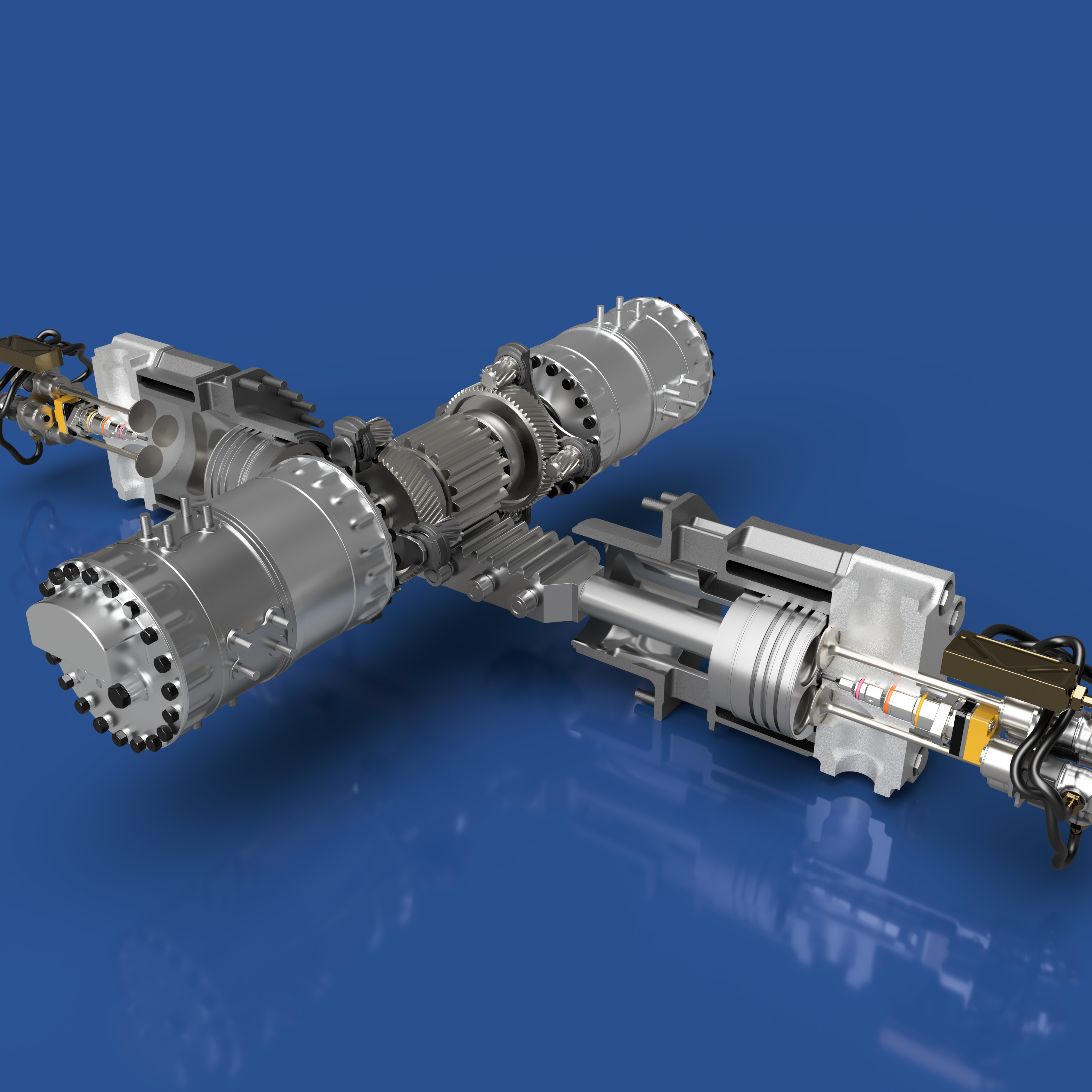
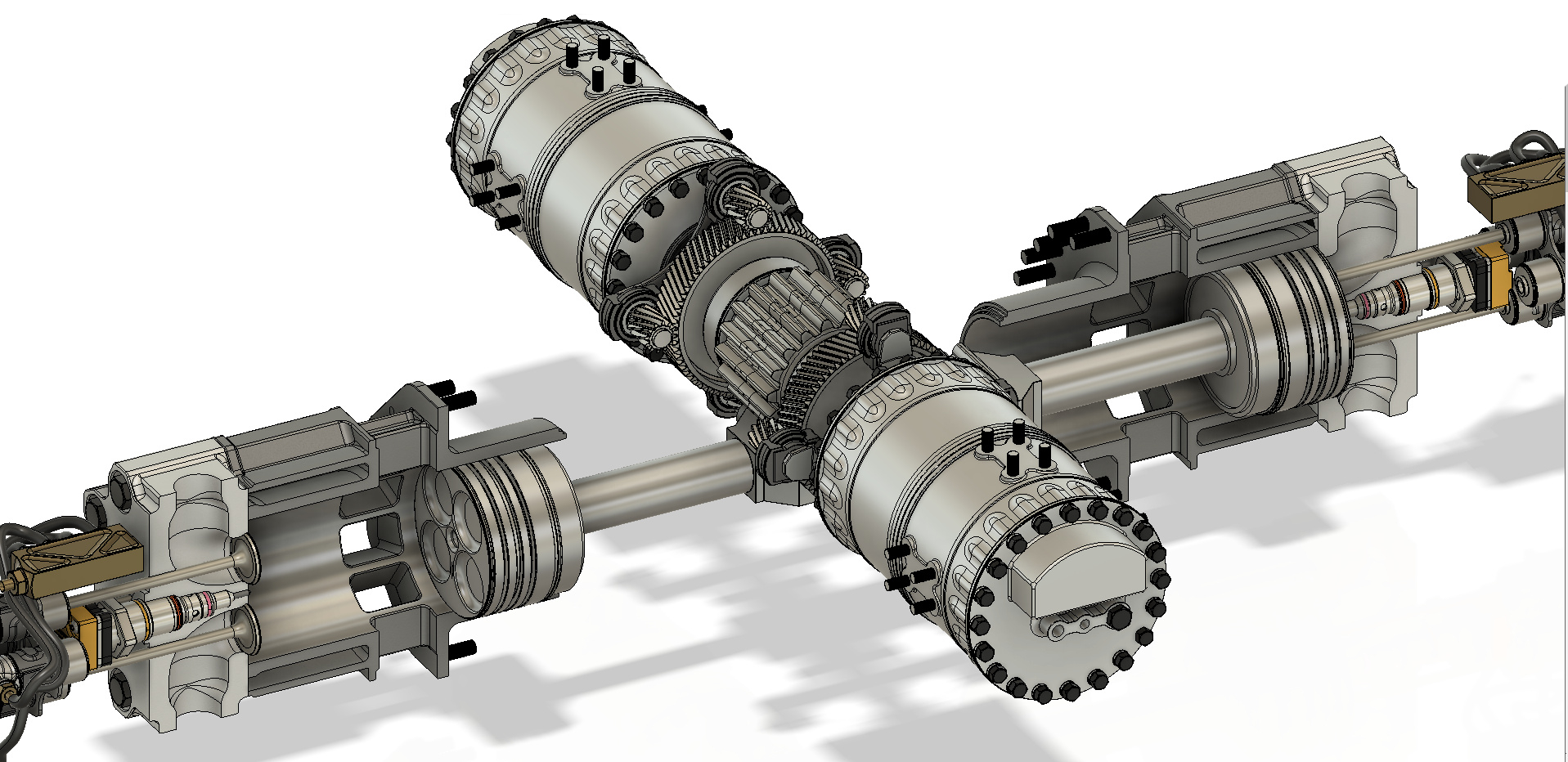
Christophe de Rivals-Mazères has conceived of a new type of free-piston engine drivetrain architecture by merging linear gear technology with high-speed synchronous motor technology to finally solve the enduring problem of practical power extraction from free-piston engines. The only known way to extract mechanical power from reciprocating motion is by using a connecting rod and a crankshaft, this method has not changed for centuries. While it can be said improving something that is already close to optimal is superfluous, the fact remains connecting rods are far from optimal. At high rates of speed, they are the single weakest link in the mighty piston engine, while they suffice for marine Diesels spinning at 60 RPM, they are hardly idyllic for 6000 RPM engines running for hours on end. The friction coefficient of metals does not increase with speed, it in fact decreases, it also decreases with increased temperature, it is commonly believed that running engines “faster” wears them faster, but only on a nominal basis, on a per distance basis, the wear rate is lower equal. Since the only way to increase the power density of a reciprocating engine is to increase its speed, it’s only rational for an engineer to search for ways to make high-speed operation smoother and less liable to catastrophic breakdown. Almost all catastrophic engine failures in race cars and other high-speed engines involve “throwing a rod”, unsurprisingly, because the connecting rod shoots down with immense force and then is violently pulled back into the cylinder. The entire thing appears inelegant and disturbing to the human eye, it’s rather a monstrosity of mechanics. In contrast, a free-piston engine always has two opposing cylinders since it does produce a full rotation on its own, it needs another piston to provide the energy for the compression stroke. As one power stroke commences, another compression stroke commences, and the reciprocation occurs in such a way that the forces are equilibrated. There is no eccentric mass, the motion is on one axis only, while a connecting rod has mass moving across two axis’s. If the engine is vertical, mass is moving along the Z axis in an up-and-down motion while mass is also moving across the X axis laterally. Connecting rods that generate eccentric rotation cannot be balanced, only the crankshaft can be truly “balanced” by using counter-weights. A change in the connecting mass distribution is unavoidable, it is built into the fundamental geometry. Vibration is inherent to any eccentric oscillation, it cannot be engineered away, this is the reason why cycloidal drives are never used at high RPM, they vibrate themselves to death. In contrast, the free-piston’s inherently smooth operation and conduciveness to high-speed operation have attracted a large amount of attention, but while the underlying architecture is sound, no method to extract power has proven successful. The bar is indeed set very high, and while Christophe Pochari EnergieTechnik does not claim to have solved it with certainty, the architecture proposed has a higher chance of succeeding than the priority. Free-pistons are the holy grail of high-power density propulsion technology, allowing diesel engines to be built using compound cycles to reach over 2.5 hp/lb potentially allowing for micro-air vehicles like jetpacks to attain ranges of over 2 hours. Higher power density through increased RPM, reduced friction, and greatly reduced or altogether eliminated vibration makes the free-piston too attractive to ignore. Propulsion is the basis of modern civilization, not electronics, but out of all the new propulsion technologies on the horizon, fuel cells, rotary detonation engines, batteries, Wankels, or exotic ceramic gas turbines simply do not live up to their promise. Unfortunately, the only way to extract power from a free-piston engine is to employ linear motors, but linear motors are severely limited in power density for the simple fact that the speed of reciprocation of even a 6000 rpm engine is only 5-7 meters per second depending on the exact stroke length. In contrast, a 30,000 rpm rotor spinning in a 150mm stator has a peripheral flux velocity of 235 m/s, a full 40x higher than the linear motor. The power density of high speed electrical machines is simply fabulous, for example, the UK company Integral Powertrain Limited makes a 243 kW motor, the SPX130-181, that weighs only 15.5 kg, translating into an imperial number of 9.55 hp/lb, compared to barely 2.5 hp/lb for a Pratt and Whitney PT6. Since linear generators are abysmal and a complete waste of time, the rack and pinion is simply the most elegant option. But the thorny issue for a rack and pinion engine is the issue of the reversal of the gear’s direction each time the engine completes its stroke. Rack and pinion engines are nothing new, the Felice Matteucci, Eugenio Barsanti, and Eugen Langen constructed linear gear engines using free-wheel clutches to produce continuous shaft rotation. Unfortunately, metal fatigue limits sprag clutch life to only 500,000 cycles, barely 1.38 hours for a 6000 RPM engine. Most other clutch designs are not much better, since the limited contact surface creates large stress concentrations. To solve this problem, we have focused on employing the unique properties of electric-drive trains, their conduciveness to high speed, and their ease of modulation. Christophe de Rivals-Mazères uses a particular design where a bank of two-high-speed synchronous generators is paired to a speed-increasing gearbox that increases the speed of the motors from the engine’s maximum of 6000 rpm to 34,000 rpm. The core of the proposed architecture is to employ a novel selectable alternating pair of synchronous motors to extract power during each power stroke while closing power production when the direction is opposite. Synchronous generators can be selectively excited by controlling the flow of current into the electromagnetic slip rings to allow the generators to be alternated to extract power from each stroke using only one generator at a time thereby preventing the generator from being reversed every stroke. A synchronous motor unlike a permanent magnet generator does not have an intrinsic magnetic field, it generates no current if its electromagnetic is off, only if its stators are working properly and the electromagnetic coils conduct electricity do they produce flux. Magnetic fields travel at the speed of light so they can be turned on and off very quickly, the time between each alternation is 10 milliseconds or 100 Hz, which is hardly a high speed by modern electrical standards. This modulation can be easily controlled with extant power electronics. The design allows a continuous supply of AC or DC power to be generated from an otherwise useless constantly reversing source of mechanical shaft power. The powerplant can then be used to drive distributed power-trains for EVTOLs, helicopters, small aircraft, or micro-air vehicles.


